This past Christmas, Santa brought me a Shark Guard. I used it to complete Nathan’s crib, but knew I’d need to get it properly mounted before the next project. So I bought a 6′ length of 1″ square tube steel, a metal cutting blade for the jigsaw, and a bag ‘o 5/16 nuts, washers and bolts. I would have much preferred to weld it together, but since I don’t own the equipment or know anyone who does, that just wasn’t going to happen.
The overarm design is about as simple as they come and there’s really not much to say about its construction that isn’t fairly obvious from the photos. The arm hinges on a bolt through a couple mending plates attached to the fixed part of the bar and is held upright by an eyebolt inserted just behind the hinge point.
Hinge and Arm Lock
The trickiest part was bolting the dang thing to the brick wall on the right side of my table saw. The bricks are fairly brittle and soft and before this project I’d had mixed results using tapcon screws. Thankfully, expansion anchors did the trick.
I’ve only had the opportunity to install this today, so I haven’t really had a chance to put it through its paces. However, so far I am impressed. The improvised packaging the unit arrived in was demonstrative of its small shop origins; the actual contents, however, were not. Installation was straightforward using the directions provided on the site. They warned that some owners of my saw (Craftsman 22124) have experienced alignment issues. I encountered this as well — leading to a bit of extra time spent applying, as suggested, small bits of foil HVAC tape to the mounting bracket. A bit of trial and error and I was in business. That is, of course, only after applying the supplied “shark face” decals, natch.
The Shark Guard Installed On My Craftsman 22124
Impressive
Overall, this is a very impressive package. The unit I received is the version 9.4 — with the big 4″ dust port and anti-kickback pawls. It also includes 3 different splitter sizes. Two for use with the guard and one “Shorty Splitter” for cutting stock with the guard removed. Swapping out the splitters is a snap, quite literally, using the spring-loaded plunger. Pull a ring and lift out the current splitter and then just slide in the new one until it “snaps” into place. The snugness of the fit is adjustable via 4 small set screws using the hex key, provided (nice touch).
Anxious to try this out, I attached a 4″ hose to the dust port, locked the guard in place and reached for a scrap of MDF. With the DC running, I experienced 100% visible dust pickup. Awesome!
Time will tell just how practical this new device will be, but at this point I completely intend on making this a near permanent fixture on my saw, removed only when the cut demands. The next step will be to build a support arm for the DC hose that will swing away when necessary. My expectation is the Shark Guard will make for both safer and cleaner table saw cuts.
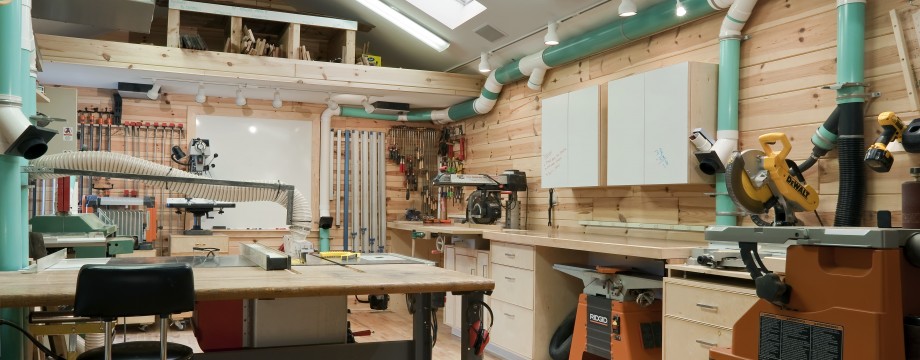
Over the past month I found very little contiguous time to make progress on the shop setup. Consequently I never felt like I had made significant enough progress in any given week to warrant a new post. While I’m still quite some distance from the finish line, I finally feel like I can actually say, once again, “I have a shop!”
Dust Collection Controls
I installed a half-dozen doorbell buttons around the shop, under bench tops near power tools, on the wall by the bandsaw and underneath the tablesaw fence next to the power switch. I installed a couple power outlets in the crawl space under the shop for the controller as well as my air compressor which I located in a corner of the crawl. I also programmed the air filter as I discussed in my last post to automatically switch on with the dust collector and off 2 minutes after the collector is switched off. I’m extremely pleased with how this has worked out.
Supplies Organized & Remaining Tools Installed
I finally managed to commit to drawer assignments for my tools and supplies. For the most part the drawers are logically organized, though a few of them are temporary “catch-alls” waiting for the day when I complete the upper cabinets. I enlisted the aid of my brother, sister-in-law and nephew to help wheel the 17″ Grizzly bandsaw up a ramp and into the shop. This turned out to be not as difficult as I’d feared it would be. I also unboxed the Ridgid oscillating sander I’d purchased nearly 3 months ago and connected both to the dust collection drops installed previously. All the tools are in!
Clamp Racks
Following some quick research at my favorite site, I assembled and mounted some clamp racks for my rather modest pipe, parallel and bar clamp collection. I still have a number of spring and “C” clamps to hang, but I’m satisfied with the arrangement for now.
A Number of Tasks Remain
No matter how much I manage to accomplish, the list never really seems to get any shorter. Some tasks that remain are setting up dust collection for my router table and building an overarm blade guard for the table saw. The router table will require installing some kind of enclosure around the hanging router…which will take some time to devise. I’m also working on a design for a tall thin “drawer” to fill the 2 spaces in the RAS cabinet. These opening are roughly 36″ tall by only 9″ wide. I’m thinking that I’ll create a sliding angled vertical panels in one to hold router bits and a vertical pull-out panel in the other for miter/RAS/table/circular saw blade storage. Next steps also include major improvements to the “large piece assembly area” — which my wife insists upon calling a “garage.” Improvements include an updated lumber rack and sheet goods pen as well as some custom cabinets for “non-wood-related” storage…though I can’t imagine what that might be.
The bottom line is that I’m just about ready to get back to spending at least some time working “in” the shop instead of “on” the shop! Hooray!
After completing my dust collection system installation, I turned to my air cleaner, the Delta 50-875. I had decided to install it just above my table saw — about 2/3rd’s of the way along the wall, where the intake would be in line with the front door and the outfeed inline with the ceiling mounted vent fan. After reading “Woodshop Dust Control” this seemed like the ideal placement and this location had the added benefit of not obscuring any usable wall space — which is at a premium in my small shop.
An Awkward Arrangement
One of the selling points of this unit is the built-in infrared remote control that allows you to install it out of reach and control it from below. The problem is that the remote sensor is in the back of the unit. While the unit location is ideal for air flow, it’s rather awkward for IR control as I’d need to walk around to the back of the unit, and to a “far” corner of the shop, to turn it on/off. I’ve always thought that what I really wanted to do was to control it with a switched outlet. The problem with that scenario is that the control panel built into the unit is solid state and doesn’t “remember” the settings when you unplug the unit. That is, if you turn it on and then switch off the outlet it’s plugged into, when you switch the outlet back on, the air cleaner will remain “off” until you again manually press the “on” key on the unit or the remote control.
So, there was no way to make this happen…or was there? I reasoned that since it’s just an electric motor and a control panel, certainly there would be a way to re-wire the unit, bypassing the built-in solid-state controls so that I could hook to a switched outlet.
Exploration
The air cleaner itself is pretty basic. It’s a rectangular metal box with a blower motor/fan in a housing, and a control panel. The motor and control panel are both mounted on the back panel which is simply screwed into the metal box. Once the backpanel assembly, including the blower was removed, I began the process of working out exactly what needed to be done to re-wire the motor. Fortunately, the motor wiring connects to wires from the controller through a nylon connector that, once unplugged provided an easy means of measuring various voltages and resistance. As I knew nothing about wiring AC motors, I began the process with a google search…many of them. Unfortunately, none provided me with anything that I could really use to definitively determine how this motor worked. In fact, I was left with more questions than I’d had originally…who knew there were so many types of AC motors! Initially, as there were 3 colored wires (Red, Blue and Black) and one White (clearly “common”), I assumed there were 3 windings and each color represented one of the 3 speeds that the unit boasts. Based on what I’d read, however, I was now concerned that the large-ish capacitor on the red wire indicated that I might have a “capacitor start” motor which would require something more complicated than simply applying voltage to one of the wires. Perhaps an electrical engineer, at this point, would have provided me a definitive way to check this out…but there weren’t any in my shop, so I tried a different tack.
I reasoned that the best way to reverse engineer this setup was to hook up each of the colored wires in turn to my volt meter — using white for common — and turn the unit on, cycle through the various speed settings and note the voltages. This did the trick. Here are the measured results:
wire
slow
medium
fast
RED
121V
9V
9V
BLUE
9V
121V
9V
BLACK
14V
14V
121V
Clearly this was going to be as straight-forward as I had first hoped! Red = slow, blue = medium and black = fast. That’s all there was to it!
Let the hacking begin…
Now I was ready to start. In thinking through exactly how I wanted to wire this up, I realized that I might want to have the ability to change the speed at some point without opening the unit up. I also figured it would be pretty simple to install a switch that would basically allow me to “undo” this hack and use the unit as nature, and the Chinese factory had intended without having to un-hang and re-open the unit. The solution was a couple toggle switches. Since there’s an Ace hardware store right up the street from my office, I decided to stop by at lunch and see what they had. I was looking for a SP3T rotary switch that would allow me to cycle through all three speeds — but the only one they had was rated at 4A max. The fuse mounted in the control panel is rated at 5A, so I figured this switch wouldn’t do. The next closest was a SPDT switch, center off — and two speeds seemed “close enough.” For the “hack bypass” switch, I got a DPDT. While it seemed like it should be sufficient to switch only the “hot” wire, since I was going to essentially be supplying power to the output of the controller when using the hack (see drawing), I was concerned that a closed common connection might allow a circuit to complete and result in “who knows what”(tm) happening. So, I decided the safest thing to do would be to simply switch both common and hot.
The plan
Here’s a basic drawing of what was done:
Moving forward
So the whole point of this modification was to allow me to control the unit by a switched outlet. The switched outlet is managed by an Insteon SwitchLinc which will allow for event-driven activation, such as turning on and off automatically with tools and/or the dust collection unit and wireless RF remote control via an X10 keychain remote. I’ll be refining the programming over the coming weeks/months.
If you read my last post you might recall how I decided to purchase an X10 “Powerflash Interface” to test out as a controller for my dust collector. My skepticism about how the unit worked turned out to be well-founded. The Powerflash device sends an X10 “on” signal when 6-18VDC is applied to the contacts — but once the voltage is removed, the unit immediately sends an “off” signal. What I was looking for was a way to use a single momentary switch to toggle the collector on and off…so that won’t do. In fact, the plan was to mount multiple doorbell-style pushbuttons around the shop and have it wired so that I didn’t have to turn the unit off at the same station where I turned it on. Since the Powerflash unit didn’t support this, I set out to basically build my own.
I’m not an electrical engineer and couldn’t design a circuit to do what I wanted, but I had no trouble finding a few options online. As a kid I used to quite literally spend hours loitering at my local Radio Shack store and would frequently spend what money I had on their “Engineer’s Notebooks” and specialty ICs to tinker with. So while I don’t fully understand the specifics of the circuits, it wasn’t much trouble reading the schematics or assembling the circuit. Of the three circuits I found online, my local Radio Shack store only stocked all of the required parts for one of them. This was, naturally, the most complicated one. It is succinctly if not aptly named Alternating ON-OFF Switch, #2.
A big box of parts…
After a couple after-work evenings, the “DustBunny 3000″ was born…
Hooked up to the “Powerflash” for testing…
Labeled and plugged into the volt meter showing ~4.74vdc on the output
And here’s the video demonstration of the system in action:
OK, so maybe not exactly a “monster,” but the old Woodtek 3HP double-bag dust collector I bought sure does sound like one…and appears to live up to its 2100CFM (free-air) rating.
I’ve finally finished the main duct work runs and over the weekend I cut the hole from the shop into the external “dust collection closet” and ran the 6″ main through. As I had feared, the dust collector argued mightily against being confined in such cramped quarters. The closet is <30" deep and ~60" wide with a standard 36"x80" door. The two-bag collector simply wouldn't make the tight turn through the doorway. Fortunately I'd half suspected this would be the case and was already mentally prepared for the situation...which likely saved my neighbors an earful.
The solution: disassembly.
I removed the upper-half, post-fan section that holds the bags to the blower and then removed the lower half, including the motor from the base. I’d already purchased a length of 6″ flexible hose that I’d planned to use to join the collector to the 6″ S&D piping…figuring that it would likely be a rather convoluted angle and possibly too tight a fit for a hard plastic 90-degree elbow. By mounting the base directly to the floor of the closet, I also gained an additional couple inches – making it now possible to use rigid fittings. Ultimately the hookup turned out to be “do-able” using rigid piping as well, eliminating the need for the rather pricey 6″ flexible hose. Anybody need any 6″ hose.
Though I don’t have any tools for measuring CFM or static pressure, my quick test sweeping some sawdust piles into the floor sweep at the very furthest end of the longest/narrowest run and hearing the swooooosh as the debris found its way swiftly into the waiting collection bags was enough to convince me that the system should do just fine. I’m hoping to do a test using the planer tonight — if it can keep up with the 13″ planer, it should have no trouble with the other tools.
My one real disappointment is with the on/off mechanism. I outfitted the 240v 20A circuit with an X10-controllable outlet and programmed the “D” button (for “Dust collection” of course) to send the appropriate on/off commands. It worked the first couple times I tried it, turning the collector on and off as expected. However, the third time I tried using the second keypad (linked to the first) and this time…nothing. I went back to the first and tried it a few more times. Again, nothing. I recall reading some forum posts (don’t recall where) by some unhappy woodworkers/X10 enthusiasts complaining about the poor reliability of X10 — specifically in the context of dust collection systems. I was planning on purchasing a “Long Ranger” or similar system and using a combination of manual switches and blast-gate mounted microswitches in the future…apparently this will need to happen a bit sooner than I’d anticipated.
As usual, the entire installation process — well, the indoor portions at least — was covered by my trusty D-Link wireless cameras. Here’s the finished video:
UPDATE: Last night I completed the “planer†test as planned. I hooked up my Rigid 13†planer to a port at the end of the run and took some fairly decent passes on a 9†piece of poplar. The dust shroud was empty. I opened a couple other blast gates and repeated the test. Still clear. Looks like this “monster†will do the job!
Not “green” in the environmental sense, mind you…but green in a very literal sense. I’ve spent literally months planning out most of the details of my new shop, since before they broke ground. One of the features I was most anxious to include that I was unable to have in my shared garage space was an honest-to-goodness central dust collection system. One of the earliest decisions I needed to make: metal or plastic?
Metal of Plastic?
I first read Sandor Nagyszalanczy’s oft recommended book “Woodshop Dust Control” where he makes a strong argument against the use of plastic PVC piping for ductwork citing the risk of explosions that could ruin your day/shop/life/etc. After reading this book it was clear to me that metal was the only way to go. That was, until I began researching actually purchasing the stuff. Expensive. What’s more, the stuff they sell at the “Big Box” stores is too thin…so the only real way to do this with metal ducting, beyond finding a local supplier (which I was unable to do) is to meticulously plot out the whole thing and place one big order to have shipped to the shop. While I’m no stranger to meticulous planning, I’ve never setup a dust collection system before and was not 100% sure I could plot this out perfectly without actually attempting to fit some pieces together first. In fact, I was pretty darn certain that I couldn’t plan this out to the last screw in advance of ordering the materials. I just knew I’d get half-way done with the install and either change my mind or realize I needed some other type of fitting(s) to finish the job. Without a local supplier, I’d be forced to place an order — likely a small one — and incur additional shipping charges and delays. Time’s too much of a premium to lose an entire day because I can’t get what I need. This realization sent me searching for alternatives.
It didn’t take long for me to find some interesting forum discussions online…but the clincher for me was this extremely well-crafted article. The upshot of reading this article was that I was now certain that I would definitely use the cheaper/easier-to-find S&D PVC piping for my system. Fortunately or Un- I was now also paranoid about what I could appreciate was the most dangerous aspect of my dust collection system — a smoldering fire in a collection bag. (Mental note: daily emptying of the bags is a must. But I digress…)
A bit of searching locally initially indicated that my local “Big Box” stores carried only up to 4″ diameter piping. My basic math says that I’d really be better off using a minimum of 5″ ducting for the main run. As S&D pipes aren’t offered in 5″, I opted for the next size up…which, as I mentioned, I was unable to locate locally. That is, until an unrelated and rare trip to Menards where I discovered all the 6″ and 4″ fittings and pipe I would ever need. Excellent.
Goin’ Green
Menards stocks their PVC piping in an outdoor lumber yard. This meant that I placed an order off a sheet with a nice picture of white 6″ PVC pipe listed as ASTM 2729 S&D. When I got into the yard, however, the pipe was actually the green stuff..ASTM 3034/SDR35. The Menards product number on the sticker on the pipe and the label on the bin matched my receipt, so I’m not sure if there was a mistake in their inventory or their labeling…or if they for some reason sell the 3034 and 2729 interchangably (seems unlikely), but I didn’t see the 2729 anywhere so I figured I’d use the somewhat heavier, green 3034 that I had paid for rather than start the hunt over again. I purchased a few 10′ lengths of the 4″ thin white stuff from Lowes as well figuring I’d at least have white drops.
Fittings
I purchased my blast gates and quick disconnect fittings from my local Woodcraft store and started the assembly. What I discovered during the assembly was that the thicker-walled SDR35 was a significantly snugger fit for the pipe fittings. Also, while a special coupling is required to attach the blast gates to 2729, they fit perfectly in the green stuff. So, while the 2729 is a bit cheaper and much lighter, I save money overall with the SDR35 since there are no adapters needed to fit the blast gates to the pipes. Serendipity.
Assembly continues apace. I’m currently roughly 50% complete with the core installation, that is the main 6″ line is 80% complete and half the drops are essentially in. I still need to build the hoods for the RAS and CMS and work out the details of the fittings for the router table, which will likely take more time than the assembly time to date. I’ve still got the two cameras capturing the process and have been sure to move them as needed as there’s no one position that can capture even most of the shop. Editing of the time-lapse is ongoing and I will be posting the completed video when the job is done, natch.
OK, so the inspections went well — though it took 3 visits from the inspector. Mostly little stuff — but Jay promptly dealt with all of the issues and we finally made it.I’m now working on getting the shop “in shape” before moving all of the tools in. This includes building a 4′ x 14′ loft 7′ 6″ from the floor at the far end. I ran conduit and wiring for (2) ceiling mounted cord reels and a track light. I still need to tape and plaster the seams and screws before I can paint it and mount the extension cords and lights.
A couple weeks ago I picked up a used (circa ’89) WoodTek 2100CFM dust collector from a guy in Indiana for $200 (Craiglist is very cool). The first thing I did was replace the power cord — which is a good thing as the ground wire had apparently become disconnected.
Last weekend I extended some of the “old shop” (a.k.a – the garage) power into the addition. I ran (1) 20A 120v, (1) 240v 15A and (1) 240v 20A circuit into the room. The 240/15 is for the tablesaw and/or bandsaw. The 240v/20A is temporarily being used with the dust collector — I plan to keep it in the shop while I build the cabinetry and fixtures. After the cabinets are complete I will be running duct work so that I can move it to its permanent home in the street-facing “closet” in the front of the shop. I’ve also installed a smoke/CO detector in the shop as well…should make it a bit easier to sleep at night after a late night in the shop.
Today I’ve decided to build an overarm blade guard/dust collector for the table saw as well. So the next steps are – complete the loft “ceiling,” build the overarm collector, build the cabinetry and workbenches.
Considering my limited amount of “free” time, I suspect this will take me through the end of the year and a bit into 2008 before I move the rest of the stationary tools in. Then there’s the shelving/upper cabinets, drawers, etc to do before the small power and hand tools are organized. This could take a while!